
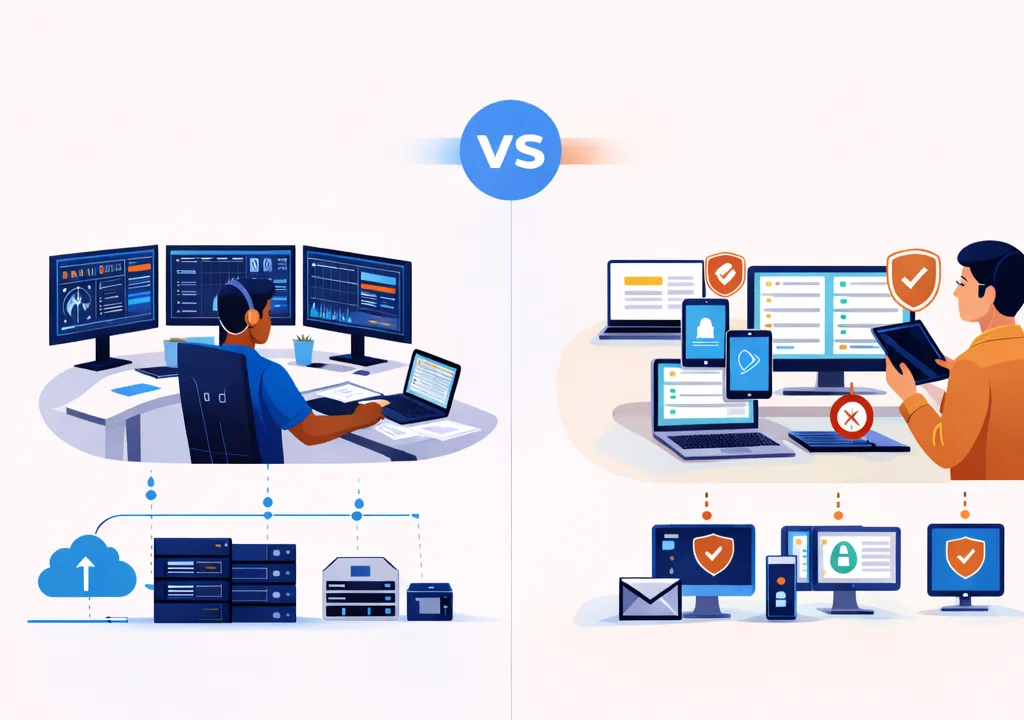
RMM and endpoint management are related but serve different roles. RMM focuses on monitoring, automation, and remote support, while endpoint management covers the broader scope of device control, policies, security, and lifecycle. RMM supports endpoint management but does not replace it.
What is RMM?
RMM, or Remote Monitoring and Management, is software used to monitor system health, automate maintenance tasks, and access devices remotely from a centralized platform.
It is primarily focused on day-to-day operations such as:
- Monitoring performance
- Detecting issues
- Running automated scripts
- Providing remote troubleshooting
What is endpoint management?
Endpoint management is the overall process of controlling and maintaining all devices within an organization.
It includes:
- Device provisioning and onboarding
- Policy enforcement and configuration
- Security management
- Lifecycle management of devices
- Compliance and governance
Endpoint management is broader and includes strategy, control, and long-term management.
What is the main difference between RMM and endpoint management?
The key difference is scope.
- RMM is a tool used for monitoring, automation, and remote operations
- Endpoint management is the overall approach to managing devices throughout their lifecycle
RMM is one part of endpoint management, not the entire solution.
How do their functions differ?
RMM focuses on:
- Real-time monitoring
- Alerting and issue detection
- Automation of routine tasks
- Remote access and troubleshooting
Endpoint management focuses on:
- Device setup and provisioning
- Policy enforcement and compliance
- Security controls and access management
- Long-term device lifecycle
RMM handles operational tasks, while endpoint management covers the full management strategy.
How do RMM and endpoint management work together?
RMM and endpoint management are often used together.
Example:
- Endpoint management defines policies and configurations
- RMM monitors devices and ensures those policies are maintained
- RMM automation corrects issues when deviations occur
Together, they provide both control and operational efficiency.
Which one do IT teams need?
Most IT teams need both.
- Use endpoint management for overall control, policy enforcement, and lifecycle management
- Use RMM for monitoring, automation, and day-to-day operations
Relying on only one can leave gaps in visibility or control.
What is a real-world comparison example?
RMM example:
- Detects a service failure
- Runs a script to restart the service
- Alerts IT team if needed
Endpoint management example:
- Defines which services should run
- Enforces configuration policies
- Ensures devices meet compliance standards
RMM reacts to issues, while endpoint management defines how systems should operate.
How do modern platforms combine both?
Modern IT platforms are increasingly combining RMM and endpoint management capabilities.
They provide:
- Monitoring and automation
- Policy enforcement
- Device management and control
- Centralized visibility
Some platforms, like Level, integrate these functions into a single system, reducing the need for separate tools and simplifying IT operations.
What are the benefits of understanding the difference?
Understanding the difference helps IT teams:
- Choose the right tools for their needs
- Avoid gaps in management and control
- Build a more complete IT strategy
- Scale operations more effectively
It also prevents confusion when evaluating solutions.
Summary
RMM and endpoint management serve different but complementary roles. RMM focuses on monitoring, automation, and remote support, while endpoint management covers the broader strategy of managing devices, policies, and lifecycle.
Using both together allows IT teams to maintain control, improve efficiency, and manage systems effectively at scale.
Sources
- Microsoft Learn, “Endpoint Management Overview” https://learn.microsoft.com
- IBM, “What is Endpoint Management?” https://www.ibm.com/topics/endpoint-management
- Red Hat, “IT Automation and Management” https://www.redhat.com/en/topics/automation