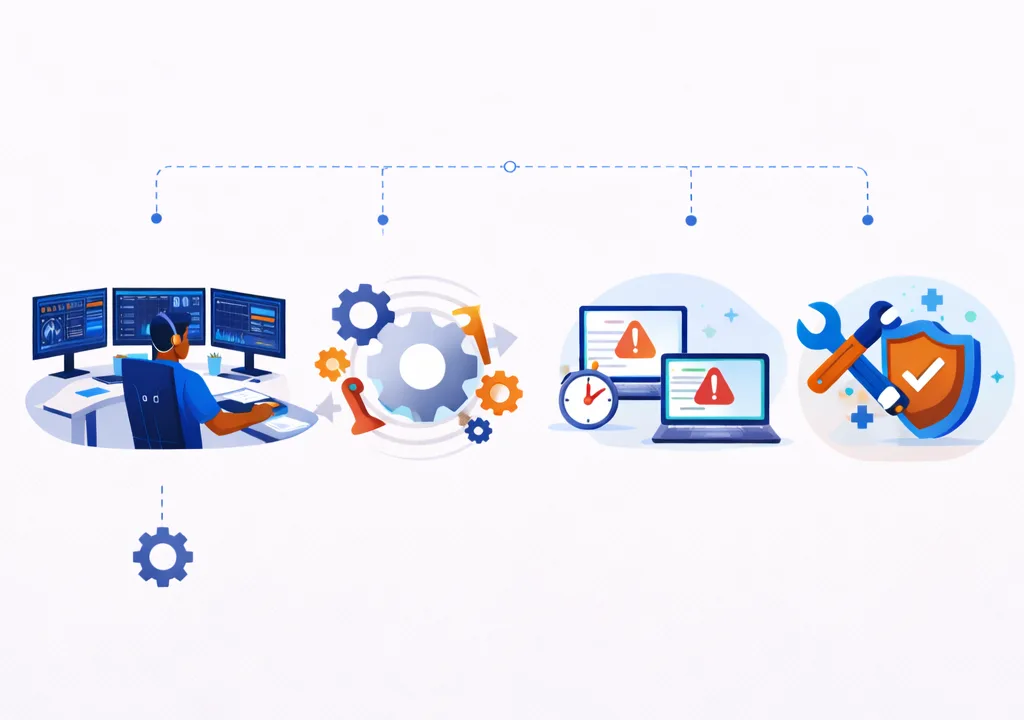
RMM software helps IT teams improve efficiency, reduce manual work, and manage systems at scale. It combines monitoring, automation, and remote access to enable faster issue resolution, better visibility, and more consistent system management.
Why do organizations use RMM software?
Organizations use RMM software to simplify IT operations and maintain control over their environments. As systems grow more complex and distributed, managing devices manually becomes inefficient.
RMM provides a centralized way to monitor, manage, and maintain systems without needing constant manual intervention.
How does RMM software improve efficiency?
RMM improves efficiency by automating routine IT tasks.
Instead of:
- Checking systems manually
- Running repetitive maintenance tasks
- Managing devices one by one
IT teams can:
- Monitor all devices from one platform
- Automate maintenance and updates
- Execute tasks across multiple endpoints simultaneously
This reduces time spent on repetitive work.
How does RMM software reduce manual workload?
Automation within RMM eliminates many day-to-day tasks.
Examples include:
- Automated patch deployment
- Scheduled system checks
- Script execution across devices
This allows IT teams to focus on more complex and strategic work instead of routine maintenance.
How does RMM software improve response time?
RMM enables real-time monitoring and automated responses.
- Issues are detected immediately
- Alerts are triggered based on conditions
- Automation can resolve problems instantly
This reduces response time from hours to seconds.
How does RMM software improve visibility?
RMM provides centralized visibility across all systems.
IT teams can:
- View device status in real time
- Track performance and health metrics
- Identify issues quickly
This improves oversight and decision-making.
How does RMM software improve system reliability?
RMM helps maintain stable and consistent environments.
- Continuous monitoring detects issues early
- Automation ensures routine maintenance is performed
- Standardized processes reduce variability
This leads to more reliable system performance.
How does RMM software support scalability?
RMM allows IT teams to manage more systems without increasing workload.
- Actions can be applied across all devices simultaneously
- Automation handles repetitive tasks at scale
- Centralized management simplifies operations
This enables organizations to grow without adding complexity.
How does RMM software improve remote management?
RMM is designed for managing distributed environments.
IT teams can:
- Access devices remotely
- Troubleshoot issues without on-site visits
- Maintain systems regardless of location
This is essential for remote work and multi-site organizations.
How does RMM software improve security?
RMM contributes to better security practices.
- Ensures timely patching and updates
- Enforces configurations and policies
- Detects anomalies and potential threats
Automation reduces the risk of missed updates or delayed responses.
What is a real-world example of RMM benefits?
Example:
- A device experiences high disk usage
- RMM detects the issue automatically
- Cleanup script is executed
- Alert is sent only if the issue persists
Another example:
- Missing updates are identified
- Patches are deployed automatically
- Compliance reports are generated
These processes reduce manual effort and improve system health.
How do modern RMM platforms enhance these benefits?
Modern RMM platforms simplify and extend these advantages.
They offer:
- Cloud-based deployment
- Faster onboarding
- Integrated automation workflows
- Centralized visibility
Some platforms, like Level, combine monitoring, automation, and endpoint management into a unified system, making it easier to manage IT operations efficiently.
What are the limitations to consider?
While RMM offers many benefits, there are considerations:
- Requires proper configuration
- Over-alerting can create noise
- Automation must be carefully managed
These can be addressed with proper setup and ongoing optimization.
Summary
RMM software provides benefits such as improved efficiency, reduced manual workload, faster response times, better visibility, and scalable IT management. By combining monitoring, automation, and remote access, it enables IT teams to operate more effectively and maintain reliable systems.
As IT environments grow, RMM becomes a critical tool for managing complexity and maintaining control.