
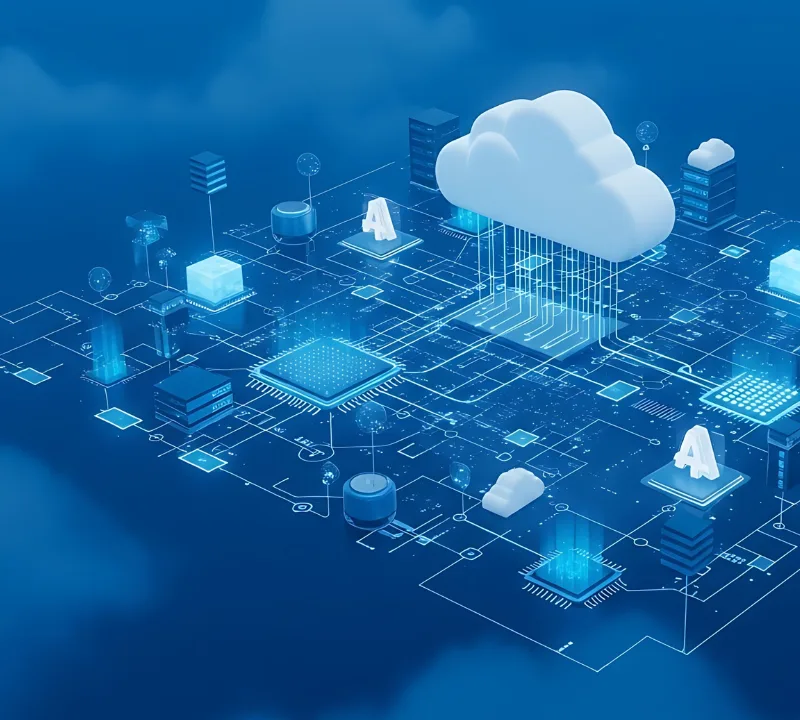
Hybrid cloud have moved from buzzword to baseline. Most organizations now operate across a mix of on-prem infrastructure, public cloud platforms, SaaS applications, and remote endpoints. The question is no longer whether to adopt hybrid cloud. The question is how to operate it effectively.
This guide explains what hybrid cloud is, how it has evolved in the past two years, where it is heading next, and what it means for IT teams managing modern infrastructure.
What Hybrid Cloud Computing Really Means
Hybrid cloud computing combines on-prem infrastructure or private cloud environments with public cloud platforms. Workloads and data move between these environments securely and operate as one unified system.
Some systems remain in local data centers or private environments where organizations need control, low latency, or compliance guarantees. Others run on public cloud platforms to take advantage of scalability, global reach, and on-demand resources.
Instead of choosing between cloud and on-prem, organizations now use both strategically.
Why Hybrid Cloud Exists
Full cloud migration is not realistic for many organizations. Several factors drive hybrid adoption.
Legacy applications often cannot be easily migrated. Compliance and data sovereignty requirements require certain data to remain local. Performance-sensitive workloads may need low latency. Costs must be balanced between predictable workloads and burst demand. Security and operational control remain critical.
Hybrid cloud allows organizations to modernize gradually without forcing a full migration.
How Hybrid Cloud Works Technically
Hybrid environments rely on secure connectivity, workload portability, and unified management.
Secure connectivity is typically implemented using site-to-site VPNs or dedicated private connections. These create secure bridges between local infrastructure and cloud platforms.
Workloads can run on local servers, cloud virtual machines, or container platforms such as Kubernetes. Applications can move between environments depending on cost, performance, and demand.
Unified management tools help teams control identity, monitoring, backup, disaster recovery, and security policies across both environments. The goal is to operate multiple environments as a single platform.
Common Hybrid Cloud Use Cases
Hybrid cloud supports several real-world scenarios.
Cloud bursting allows applications to run on-prem normally but scale into the cloud during peak demand. Backup and disaster recovery use the cloud for resilience while keeping primary systems local. Sensitive data can remain on-prem to meet compliance requirements while applications run in the cloud. Many organizations use hybrid cloud for gradual migration, moving workloads in phases instead of all at once.
Hybrid Cloud in the Past Two Years
The biggest shift in the past two years is mindset. Hybrid cloud moved from transitional architecture to default enterprise architecture.
Hybrid Became the Default Model
Organizations no longer view hybrid as a stepping stone. It is now the long-term operating model. Cloud-first strategies evolved into hybrid-by-design approaches as organizations recognized the benefits of combining environments.
The realization was simple. Full cloud migration can be expensive. Some workloads run better on-prem. Compliance requires local control. Vendor lock-in introduces risk. Hybrid solves these challenges.
Cost Optimization Took Center Stage
Two years ago, cloud discussions focused on scalability. Today the focus is cost control.
Organizations discovered significant cloud waste and began balancing workloads between environments. Predictable workloads often move back on-prem while burst workloads remain in the cloud. This shift, often called cloud repatriation, made hybrid cloud the financial control model.
Multi-Cloud and Hybrid Merged
Hybrid originally meant on-prem plus one cloud. Multi-cloud meant multiple public clouds. Today these strategies are intertwined.
Organizations now distribute workloads across on-prem infrastructure, multiple cloud providers, and SaaS platforms. This hybrid multi-cloud approach has become the modern architecture.
AI Accelerated Hybrid Adoption
Artificial intelligence workloads dramatically changed infrastructure needs. AI requires massive compute bursts, large datasets, and consistent performance.
Organizations discovered that running AI entirely in the public cloud can be expensive. Data gravity keeps large datasets close to where they are generated. Hybrid cloud supports both needs by combining elasticity with control.
Edge Computing Joined the Hybrid Model
Hybrid now extends beyond cloud and data center to include edge computing. Real-time analytics, IoT systems, and low latency applications require processing closer to users and devices. Hybrid cloud has become a three-layer architecture spanning cloud, on-prem, and edge.
Security and Data Sovereignty Became Priorities
Regulatory requirements and geopolitical concerns increased focus on data sovereignty and vendor independence. Hybrid cloud helps organizations maintain control while still benefiting from cloud services.
The Next Two Years of Hybrid Cloud
The next phase of hybrid cloud is optimization and automation.
AI-Driven Hybrid Operations
Hybrid infrastructure will become increasingly automated. Artificial intelligence will help manage workload placement, scaling, cost optimization, and performance tuning. Infrastructure will become more predictive and self-optimizing.
Cross-Cloud Networking Will Improve
Historically, moving data between clouds has been complex. Rapid improvements in cross-cloud networking will make hybrid environments feel more unified and easier to manage.
Rising Cloud Costs Will Drive Hybrid Adoption
Growing demand for AI infrastructure is expected to increase cloud costs. Organizations will continue balancing workloads between cloud and on-prem environments to control spending.
Legacy Systems Will Be Modernized
Instead of replacing legacy infrastructure, organizations are modernizing and integrating it into hybrid environments. Hybrid supports modernization without requiring full replacement.
Hybrid Will Power AI and Real-Time Platforms
Hybrid cloud is becoming the foundation for AI, analytics, and real-time data platforms. These workloads require centralized compute, local processing, and continuous data streaming.
Hybrid Will Become the Standard Platform
Within the next few years, hybrid will no longer be considered a deployment model. It will be the standard operating environment for modern IT.
What Hybrid Cloud Means for IT Teams
Hybrid cloud changed the role of IT teams. Instead of managing infrastructure in a single location, teams now orchestrate services across distributed environments.
Managing Environments Instead of Locations
IT teams now manage on-prem servers, multiple cloud platforms, SaaS tools, remote endpoints, and edge devices. Infrastructure is distributed by default.
Visibility Becomes Critical
Hybrid environments require strong visibility into workloads, endpoints, data location, and system dependencies. Without centralized visibility, hybrid become difficult to manage.
Endpoint Management Becomes Strategic
Endpoints are now cloud access points. Every device connects users to hybrid infrastructure. Managing endpoints is now part of the architecture.
Automation Becomes Mandatory
Hybrid environments introduce constant change. Automation is required for patching, deployment, onboarding, and compliance enforcement.
Security Becomes Identity-Centric
The traditional network perimeter is gone. Security now depends on identity, device trust, and endpoint posture.
Cost Management Joins IT Responsibilities
IT teams now monitor cloud spending, SaaS usage, and infrastructure efficiency as part of daily operations.
Vendor Management Expands
Hybrid environments rely on multiple vendors. IT teams must evaluate integrations, roadmaps, and long-term compatibility.
Disaster Recovery Becomes Multi-Platform
Resilience planning now spans cloud providers, data centers, and remote infrastructure.
Skills Must Evolve
Hybrid cloud requires expertise in automation, cloud platforms, security, networking, and endpoint management.
Where Level Fits in the Hybrid Cloud Reality
Hybrid cloud created a major operational gap. Cloud platforms manage cloud resources. Data center tools manage servers. Security platforms manage identities. The device layer connecting everything often becomes fragmented.
This is where modern endpoint management platforms play a critical role.
Hybrid Cloud Starts at the Endpoint
Every hybrid workflow depends on endpoints. Employees access SaaS applications from laptops. Servers connect to cloud workloads. Devices authenticate to identity providers. VPNs bridge networks. Backup agents move data between environments.
Endpoints are cloud access points, security boundaries, and data entry points. If endpoints are not visible and controlled, hybrid security breaks down.
Visibility Across Distributed Environments
Hybrid cloud requires answers to questions about device health, updates, and dependencies. Level helps IT teams maintain real-time visibility across endpoints regardless of location.
Automation Across Environments
Hybrid infrastructure creates constant change. Level helps automate patching, deployment, onboarding, and routine maintenance across distributed devices.
Supporting Security and Zero Trust
Compromised endpoints can expose credentials and provide access to cloud resources. Maintaining device health and configuration supports modern security strategies.
Enabling Long-Term Infrastructure Planning
Hybrid cloud is the long-term operating model. IT teams need tools that scale, simplify operations, and reduce tool sprawl. Level provides centralized endpoint management that supports distributed infrastructure.
Final Thoughts
Hybrid cloud is now the foundation of modern IT. Over the past two years it became the default architecture. Over the next two years it will become more automated, more interconnected, and more critical to business operations.
For MSPs and internal IT teams, success in the hybrid era depends on visibility, automation, and unified management across devices and environments.
Understanding and preparing for this shift today helps organizations build resilient and future-ready infrastructure.