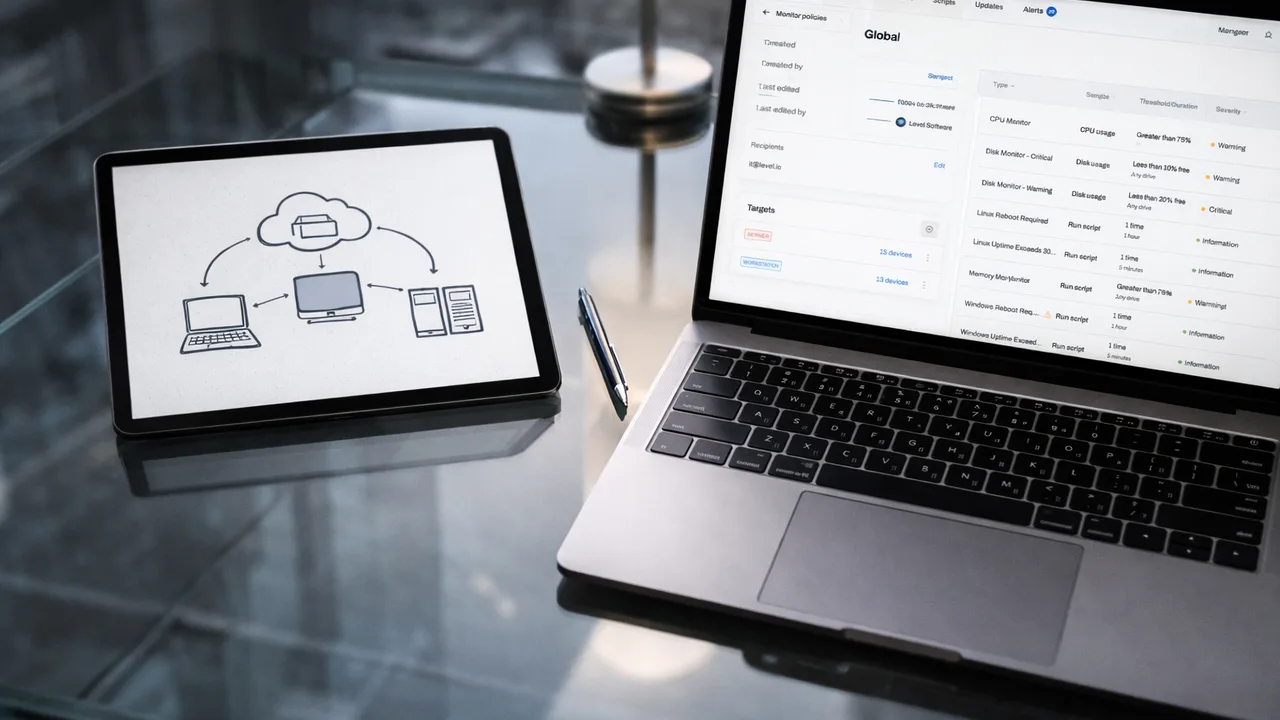
Endpoint management and RMM serve different roles. Endpoint management is the broader practice of monitoring, securing, and maintaining devices, while RMM is the tool used to perform those tasks remotely. Endpoint management defines the strategy, and RMM provides the execution.
What is endpoint management?
Endpoint management is the overall process of managing devices such as laptops, desktops, servers, and mobile devices within an IT environment.
It includes:
- Monitoring device health and performance
- Enforcing security policies
- Managing configurations and access
- Maintaining devices throughout their lifecycle
It is a practice, not a specific tool.
What is RMM?
RMM, or Remote Monitoring and Management, is software that allows IT teams to monitor and control endpoints remotely.
It typically provides:
- Real-time monitoring and alerts
- Remote access and troubleshooting
- Patch management and updates
- Automation through scripts and policies
RMM is one of the primary tools used to carry out endpoint management.
What is the main difference between endpoint management and RMM?
The key difference is scope.
- Endpoint management is the strategy and process
- RMM is the tool used to execute that strategy
Endpoint management defines what needs to be done, while RMM enables how it gets done.
How do endpoint management and RMM work together?
RMM platforms are used to implement endpoint management practices.
Together they allow IT teams to:
- Monitor all devices from a centralized dashboard
- Automate routine maintenance tasks
- Enforce policies across endpoints
- Respond to issues remotely
RMM acts as the operational layer of endpoint management.
Can you have endpoint management without RMM?
Yes, but it becomes inefficient and difficult to scale.
Without RMM:
- Tasks are performed manually
- Visibility across devices is limited
- Response times are slower
- Consistency across endpoints is harder to maintain
Most modern IT environments rely on RMM to manage endpoints effectively.
Does RMM include endpoint security?
RMM can include security features, but it is not limited to security.
It may offer:
- Antivirus integrations
- Patch management
- Monitoring for suspicious activity
However, endpoint management includes broader security strategy and policy enforcement beyond what RMM alone provides.
How do IT teams choose between endpoint management and RMM?
This is not a choice between two competing options.
Instead:
- Endpoint management is the goal
- RMM is part of the solution
IT teams typically adopt RMM platforms to support their endpoint management strategy.
When is RMM most useful?
RMM is especially useful when:
- Managing remote or distributed devices
- Supporting multiple environments or clients
- Automating repetitive IT tasks
- Scaling operations without increasing staff
It enables efficient, centralized control across many endpoints.
What are common misconceptions about endpoint management vs RMM?
Some common misunderstandings include:
- Thinking they are interchangeable
- Assuming RMM covers all aspects of endpoint management
- Viewing endpoint management as only a tool
In reality, endpoint management is the broader discipline, while RMM is a key component within it.
FAQ
Is RMM the same as endpoint management?
No, RMM is a tool used to perform endpoint management tasks, not the entire process.
Do all businesses need RMM?
Most organizations with multiple devices benefit from RMM, especially those with remote or distributed systems.
Can endpoint management exist without automation tools?
Yes, but it becomes inefficient and harder to maintain at scale.
Is RMM only for MSPs?
No, internal IT teams also use RMM to manage their environments.
Summary
Endpoint management and RMM are closely related but not the same. Endpoint management is the broader practice of managing devices, while RMM is the tool that enables remote monitoring, automation, and control. Together, they allow IT teams to manage devices efficiently at scale.
Sources
- Microsoft Learn, Endpoint management concepts and tools
- IBM, Endpoint management vs monitoring tools
- Cisco, Remote monitoring and endpoint management fundamentals