
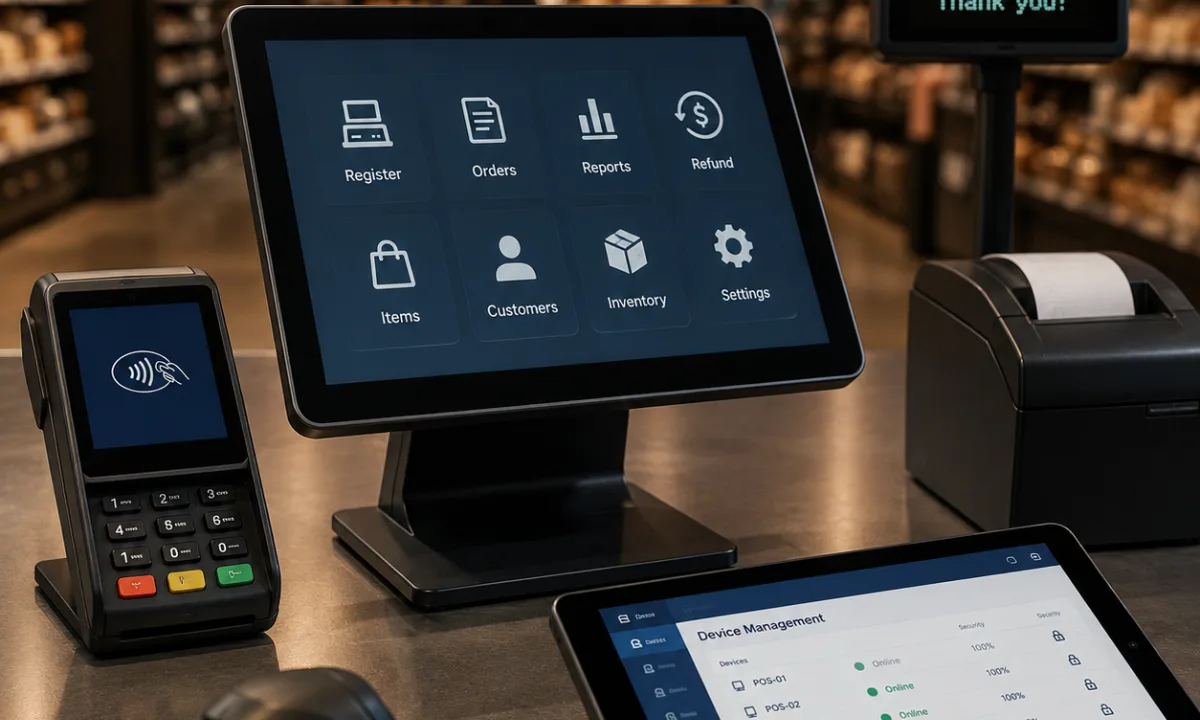
Retail endpoint management is the centralized administration of every computing device used across retail operations, including point-of-sale (POS) terminals, payment systems, employee laptops, handheld inventory scanners, tablets, kiosks, digital signage, store servers, and mobile devices. Effective endpoint management helps IT teams maintain visibility into distributed environments, automate routine maintenance, improve security, and support business continuity across every location.
Unlike a traditional office environment, retailers often operate dozens or hundreds of geographically dispersed stores with limited or no onsite IT staff. Devices must remain secure, consistently configured, and available without interrupting customer service or daily operations. Building a successful retail endpoint management strategy requires more than simply deploying devices. It requires continuous visibility, standardized management, proactive maintenance, and well-defined security practices based on established frameworks from organizations including the National Institute of Standards and Technology (NIST), the Center for Internet Security (CIS), the PCI Security Standards Council (PCI SSC), and the Federal Trade Commission (FTC).
What Is Retail Endpoint Management?
Retail endpoint management is the process of centrally deploying, configuring, monitoring, securing, updating, and maintaining every endpoint throughout its lifecycle.
Retail endpoints commonly include:
- POS terminals
- Payment devices
- Employee workstations
- Store laptops
- Tablets
- Handheld inventory scanners
- Self-service kiosks
- Digital signage
- Store servers
- Mobile devices
- Network-connected IoT equipment
Unlike many industries, retail environments combine customer-facing technology with operational infrastructure across multiple locations. Every endpoint contributes to business operations, making consistency and visibility critical.
The NIST Cybersecurity Framework (CSF) 2.0 provides a useful structure for managing these environments through its six functions: Govern, Identify, Protect, Detect, Respond, and Recover. Together, these functions help organizations understand what assets they own, secure them appropriately, detect issues early, respond effectively, and recover from disruptions.
Why Retail Endpoint Management Is Different
Managing endpoints in retail presents challenges that extend beyond those found in many centralized office environments.
Retail organizations frequently support:
- Multiple store locations
- Corporate offices
- Warehouses
- Distribution centers
- Seasonal locations
- Temporary kiosks
- Remote employees
Each location may contain different hardware, software, network connectivity, and operational requirements.
For example, a POS terminal processing customer payments has different security requirements than a digital display showing promotions. A handheld inventory scanner used in a warehouse has different software requirements than a tablet used by store associates.
According to NIST SP 1800-5: IT Asset Management, maintaining an accurate and continuously updated inventory of enterprise assets is fundamental to understanding security posture and supporting operational efficiency across distributed environments.
Without complete visibility, retail IT teams may struggle to answer essential operational questions:
- Which devices are currently online?
- Which stores are missing security updates?
- Which endpoints have unauthorized software?
- Which systems no longer meet configuration standards?
- Which devices are approaching end of life?
Complete Asset Visibility Comes First
You cannot effectively manage endpoints that have not been identified.
Both NIST SP 1800-5 and CIS Control 1: Inventory and Control of Enterprise Assets emphasize maintaining an accurate inventory of enterprise assets throughout their lifecycle.
For retailers, that inventory should include:
- Device type
- Operating system
- Installed software
- Physical location
- Assigned owner
- Hardware model
- Warranty information
- Support status
- Network connectivity
Software visibility is equally important. CIS Control 2: Inventory and Control of Software Assets recommends identifying authorized software, removing unauthorized applications, and reducing unnecessary software that can introduce operational or security risks.
Accurate inventories also support the Identify function of the NIST CSF by giving organizations the information needed to manage risk across every location.
Standardize Device Configurations
Configuration inconsistencies are one of the most common causes of operational problems.
If one store installs unauthorized software, disables security controls, or changes system settings, troubleshooting becomes more difficult and security risk increases.
CIS Control 4: Secure Configuration of Enterprise Assets and Software recommends establishing documented baseline configurations that can be consistently applied across enterprise assets. The CIS Benchmarks provide consensus-based recommendations for securely configuring operating systems, applications, cloud services, and network devices.
Standardized configurations help retailers:
- Reduce configuration drift
- Simplify support
- Improve deployment consistency
- Reduce unnecessary services
- Improve operational reliability
- Strengthen security
This supports both the Protect function of the NIST CSF and day-to-day operational efficiency.
Prioritize Patch Management
Retail operations cannot always install updates immediately. Many organizations schedule maintenance during off-hours to minimize disruption to customers and employees.
NIST SP 800-40 Rev. 4: Guide to Enterprise Patch Management Planning recommends treating patch management as preventive maintenance rather than waiting until vulnerabilities become operational problems.
NIST SP 1800-31: Improving Enterprise Patching for General IT Systems demonstrates how organizations can combine asset inventories, vulnerability information, software distribution, verification, and temporary mitigations into a coordinated patch management process.
An effective retail patch management strategy typically includes:
- Automated deployment
- Risk-based prioritization
- Maintenance scheduling
- Deployment verification
- Exception management
- Rollback planning
- Emergency update procedures
Keeping software current reduces operational risk while supporting the Protect function of the NIST CSF.
Secure Mobile Retail Devices
Retail employees increasingly rely on mobile technology for inventory management, assisted selling, order fulfillment, and store communications.
NIST SP 800-124 Rev. 2: Guidelines for Managing the Security of Mobile Devices in the Enterprise recommends managing mobile devices throughout their lifecycle, including enrollment, authentication, application management, monitoring, maintenance, and secure retirement.
The FTC Cybersecurity for Small Business guidance also recommends maintaining inventories of business devices, applying software updates, protecting accounts, and following cybersecurity best practices to reduce operational risk.
Consistent mobile device management helps retailers maintain productivity while reducing the impact of lost, stolen, or compromised devices.
Continuously Monitor Endpoint Health
Endpoint management is not a one-time deployment project.
Devices change over time as software is updated, configurations evolve, hardware ages, and new vulnerabilities emerge.
CIS Control 7: Continuous Vulnerability Management recommends continuously identifying, prioritizing, and remediating vulnerabilities across enterprise assets.
Retail IT teams should routinely monitor for:
- Missing security updates
- Unsupported operating systems
- Configuration drift
- Unauthorized applications
- Devices that fall outside approved baselines
- Hardware approaching replacement
Continuous monitoring supports the Detect function of the NIST CSF by improving an organization's ability to identify operational and security issues before they significantly affect business operations.
Protect Payment Systems
Payment systems require additional attention because they process customer payment information.
The Payment Card Industry Data Security Standard (PCI DSS v4.0.1) establishes security requirements for systems that store, process, or transmit payment account data. These requirements include secure configurations, authentication, malware protection, vulnerability management, logging, testing, and access controls.
Retail organizations should also monitor updates published through the PCI Security Standards Council Document Library, which provides supporting guidance and implementation resources.
While endpoint management does not by itself achieve PCI DSS compliance, it can support compliance efforts by helping organizations maintain consistent configurations, deploy updates, and monitor endpoint health.
Adopt Zero Trust for Distributed Retail
Modern retail environments extend beyond store networks.
Employees work from multiple locations, vendors may require limited access, and devices regularly communicate across stores, warehouses, and corporate offices.
NIST SP 800-207: Zero Trust Architecture recommends making access decisions based on identity, device posture, and contextual information rather than assuming trust because a user or device is connected to the network.
NIST SP 1800-35: Implementing a Zero Trust Architecture provides implementation guidance that organizations can use when applying these principles.
For retailers, Zero Trust helps reduce unnecessary access between payment environments, back-office systems, warehouse infrastructure, and corporate resources.
Prepare for Operational Incidents
Even well-managed environments experience hardware failures, software issues, and cybersecurity incidents.
NIST SP 800-61 Rev. 3: Incident Response Recommendations and Considerations for Cybersecurity Risk Management recommends preparing incident response processes before incidents occur, including procedures for detection, analysis, containment, recovery, communication, and continuous improvement.
When endpoint inventories, configurations, and monitoring systems are well maintained, IT teams can more quickly identify affected devices, isolate problems, restore operations, and reduce business disruption. These activities align with the Respond and Recover functions of the NIST CSF.
How Level Supports Retail Endpoint Management
Managing retail endpoints at scale requires visibility across every location without requiring constant onsite support.
Level helps IT teams centrally monitor endpoint health, automate routine maintenance, remotely manage distributed devices, and maintain operational visibility across stores, warehouses, and corporate environments. Combined with established guidance from NIST, CIS, PCI SSC, and the FTC, centralized endpoint management helps organizations build more secure, consistent, and resilient retail operations.
Frequently Asked Questions
What is a retail endpoint?
A retail endpoint is any computing device used to support retail operations, including POS terminals, payment devices, laptops, tablets, handheld scanners, kiosks, digital signage, store servers, and mobile devices.
Why is endpoint visibility important in retail?
Complete endpoint visibility helps IT teams identify managed devices, deploy updates, maintain secure configurations, monitor device health, and support incident response across distributed retail environments.
Does endpoint management help with PCI DSS?
Yes. Endpoint management can support PCI DSS compliance efforts by helping organizations maintain consistent configurations, manage software updates, monitor endpoint health, and improve operational visibility. However, endpoint management alone does not satisfy PCI DSS requirements.
How often should retail endpoints be patched?
Patch schedules depend on organizational risk, vendor guidance, operational requirements, and maintenance windows. NIST recommends treating patch management as an ongoing preventive maintenance process rather than a reactive activity.