
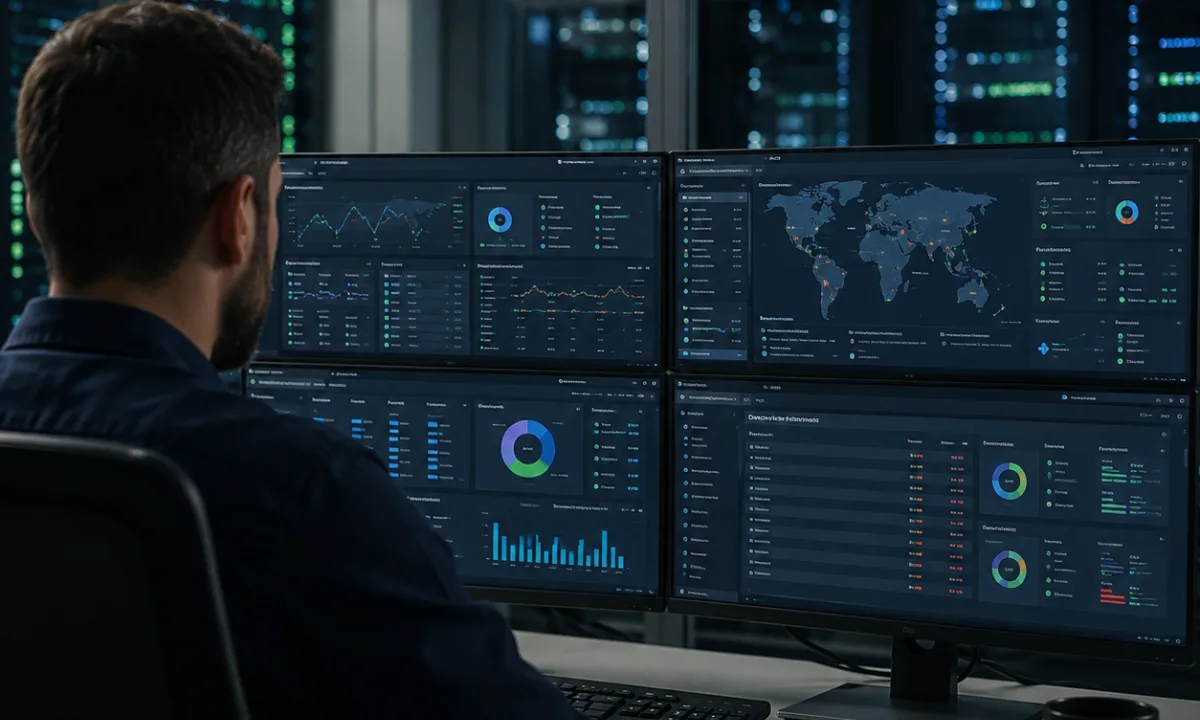
Operational visibility is the ability to understand the current state of your IT environment using continuously collected operational data. Instead of relying on isolated alerts or individual monitoring tools, it brings together information about hardware, software, networks, applications, users, logs, metrics, traces, and security events to help IT teams make informed operational decisions.
As organizations expand across cloud platforms, remote work, mobile devices, and hybrid infrastructure, maintaining visibility becomes increasingly difficult. Gaps in operational data can slow troubleshooting, complicate incident response, delay patching, and make it harder to understand how changes affect business-critical services.
This article explains what operational visibility is, how it differs from monitoring and observability, why it matters, and the practices that help organizations build a more complete view of their IT environment.
What Is Operational Visibility?
Operational visibility is the ability to understand the health, performance, activity, and security of IT assets through continuously collected operational data. Rather than focusing on a single technology, it combines information from multiple sources so IT teams can understand what is happening across their environment and determine whether action is needed.
The NIST Cybersecurity Framework (CSF) 2.0 emphasizes identifying assets, monitoring events, detecting anomalies, responding to incidents, and continuously improving cybersecurity capabilities. These activities all depend on reliable operational information.
Similarly, NIST SP 800-137: Information Security Continuous Monitoring explains that continuous monitoring involves collecting security-related information, analyzing it, and supporting ongoing risk-based decision making. Effective operational visibility typically combines these processes into an ongoing organizational capability rather than treating monitoring as a standalone activity.
Operational visibility commonly includes:
- Hardware inventory
- Software inventory
- Endpoint status
- Server and infrastructure health
- Network telemetry
- Application performance metrics
- Audit logs
- Distributed traces
- Security events
- Configuration changes
- Alerts
- Service dependencies
Why Operational Visibility Is Becoming More Difficult
Modern IT environments are far more distributed than traditional corporate networks.
Organizations now manage combinations of:
- On-premises infrastructure
- Cloud services
- Remote employees
- Mobile devices
- Virtual machines
- SaaS applications
- Internet of Things (IoT) devices
- Hybrid environments
According to NIST SP 800-215: Guide to a Secure Enterprise Network Landscape, enterprise networks increasingly span multiple technologies, environments, and trust boundaries. As infrastructure becomes more distributed, it becomes more difficult to maintain consistent awareness of systems, communication paths, operational status, and security controls.
For example, an endpoint may experience unusually high CPU utilization while application latency increases and authentication failures begin appearing in centralized logs. Looking at any one of these signals independently may not reveal the underlying issue. Bringing them together provides the operational context needed to investigate whether the cause is a software deployment, hardware failure, configuration change, or security incident.
Asset Visibility Comes First
Organizations cannot effectively manage assets they do not know exist.
The CISA Binding Operational Directive 23-01 identifies asset visibility as a foundational capability for vulnerability management. The directive distinguishes between discovering assets and understanding their vulnerabilities, emphasizing that both capabilities are necessary for effective cyber defense.
The Center for Internet Security's Control 1: Inventory and Control of Enterprise Assets recommends continuously identifying and maintaining inventories of enterprise assets, including physical devices, virtual machines, cloud resources, remote endpoints, and IoT devices.
Hardware visibility alone is not enough. CIS Control 2: Inventory and Control of Software Assets extends visibility to operating systems and applications, helping organizations identify unauthorized, unsupported, outdated, or unmanaged software.
Comprehensive hardware and software inventories provide an important foundation for monitoring, patch management, compliance, incident response, and operational planning.
Logs and Telemetry Provide Operational Context
Operational visibility depends on meaningful operational data rather than isolated alerts.
The OpenTelemetry Observability Primer explains that observability is the ability to understand a system by examining the telemetry it produces. These telemetry signals allow engineers to investigate both expected behavior and previously unknown conditions.
The OpenTelemetry Signals documentation identifies three primary forms of telemetry:
- Metrics that measure trends over time
- Logs that record individual events
- Traces that follow requests across distributed services
Generating these signals requires instrumentation. The OpenTelemetry Instrumentation guidance explains how applications and services emit standardized telemetry that can be analyzed consistently across different technologies.
Logs remain a critical component of operational visibility. NIST SP 800-92: Guide to Computer Security Log Management provides guidance for collecting, protecting, analyzing, storing, and retaining enterprise logs, while NIST SP 800-53 Revision 5 includes controls covering audit review, system monitoring, continuous monitoring, and component inventories. The CIS Audit Log Management Control reinforces these practices by recommending centralized log collection, alerting, review, and retention.
Operational Visibility vs. Monitoring
Monitoring and operational visibility are closely related but are not the same.
Monitoring focuses on collecting data and generating alerts when predefined conditions occur. Operational visibility builds on monitoring by combining information from multiple systems to provide the context needed for troubleshooting, decision making, incident response, and operational planning.
Monitoring may indicate that a server has exceeded a CPU threshold. Operational visibility helps explain how that event affects applications, users, network performance, security events, and dependent services.
In other words, monitoring answers what happened, while operational visibility helps explain what it means.
Operational Visibility vs. Observability
Observability and operational visibility are also related but serve different purposes.
According to the OpenTelemetry Observability Primer, observability focuses on understanding a system by analyzing the telemetry it produces. Operational visibility is broader. It includes observability but also incorporates asset inventories, configuration information, security events, operational workflows, and infrastructure awareness.
Observability primarily answers questions about system behavior. Operational visibility combines that information with operational context to support day-to-day IT management.
Monitoring Should Support Operational Decisions
Collecting more data does not automatically improve visibility.
Google's engineering guidance in Monitoring Distributed Systems explains that effective monitoring should help engineers answer meaningful operational questions rather than overwhelm them with unnecessary alerts. The guidance identifies four important service indicators:
- Latency
- Traffic
- Errors
- Saturation
The Site Reliability Workbook: Monitoring Systems with Advanced Analytics further explains that metrics, structured logs, traces, and event data each answer different operational questions. Combining these telemetry sources provides a more complete understanding of system behavior than relying on any single signal alone.
Operational Visibility Strengthens Security
Operational visibility also supports modern cybersecurity practices.
NIST SP 800-207: Zero Trust Architecture explains that organizations should continuously evaluate users, devices, applications, and contextual information rather than relying solely on network location. These decisions depend on current operational data about identities, assets, activity, and system state.
Likewise, the CISA Zero Trust Maturity Model Version 2.0 identifies visibility and analytics as capabilities that span identities, devices, networks, applications, workloads, and data.
When incidents occur, organizations also need reliable operational information to determine what happened, identify affected systems, prioritize response activities, and support recovery. NIST SP 800-61 Revision 3: Incident Response Recommendations and Considerations for Cybersecurity Risk Management emphasizes integrating detection, response, recovery, and continuous improvement throughout the incident management lifecycle.
Building Better Operational Visibility
Improving operational visibility is an ongoing process rather than a one-time deployment.
Many organizations begin by establishing accurate hardware and software inventories before expanding into centralized logging, telemetry collection, continuous monitoring, and correlation across operational and security data sources.
Standardizing telemetry also becomes increasingly valuable as environments grow more complex. The IETF Network Telemetry Framework (RFC 9232) describes vendor-neutral approaches for collecting configuration, operational state, event, flow, and performance data across modern networks.
For IT teams managing endpoints, servers, and distributed infrastructure, platforms such as Level can naturally complement these practices by centralizing device inventory, endpoint monitoring, alerting, and operational insights. Operational visibility, however, typically depends on information from multiple operational data sources rather than any single product.
Frequently Asked Questions
Why is operational visibility important?
Operational visibility helps IT teams detect issues faster, understand how problems affect users and services, improve incident response, strengthen security, and make better operational decisions using accurate, continuously updated information.
What is the difference between operational visibility and network visibility?
Network visibility focuses on traffic, devices, connections, and network performance. Operational visibility is broader, combining network information with endpoint data, applications, infrastructure, software inventories, logs, telemetry, security events, and service dependencies.
What tools contribute to operational visibility?
Organizations often combine endpoint management, asset discovery, centralized logging, telemetry collection, monitoring platforms, and analytics tools to create a more complete operational picture. Each contributes different types of operational data that together improve visibility.
Operational Visibility Is an Ongoing Capability
Operational visibility is more than a dashboard or monitoring platform. It is an organizational capability built on accurate asset inventories, software awareness, standardized telemetry, effective log management, continuous monitoring, and meaningful analysis.
As IT environments continue to expand across cloud services, remote endpoints, and hybrid infrastructure, organizations that invest in operational visibility are better positioned to troubleshoot problems faster, improve reliability, strengthen security, and support informed operational decision making.